CMHC

Project Context
Partnering with CMHC on the Housing Benefits Transformation initiative, I led UX strategy and systems-level design for a large-scale digital modernization program supporting the delivery of housing programs under Canada’s National Housing Strategy. The project focused on improving the clarity, accessibility, and operational efficiency of digital systems used to administer housing benefits and support service delivery across complex program environments.
The work began with a discovery and alignment phase, where we analyzed existing workflows, program requirements, stakeholder needs, and system constraints. Through stakeholder conversations, user research, and collaboration with product, business, and technical teams, we identified key design challenges, including fragmented workflows, complex role-based access needs, inconsistent interaction patterns, and the need for a scalable enterprise UX architecture.
Through this process, I helped define a more structured and accessible design direction for the platform, aligning service design, information architecture, workflow design, and enterprise system requirements. The final approach supported clearer task flows, stronger accessibility integration, reusable design patterns, and a more consistent authenticated experience for internal program staff and external service participants.
Role
Role Principal UX Consultant, Digital Transformation Lead
Collaborators
Product Owners, Creative Director, Business Analyst, Developers, Subject Matter Experts
Project Timeline
11 months
Methods and Tools
Design Thinking, UX Strategy, Design System, Figma, Miro, Microsoft, Adobe, Jira
Process
For CMHC’s Housing Benefits Transformation initiative, we followed a structured design thinking and systems design process to create a scalable, accessible, and operationally efficient digital service experience.
Through discovery, we conducted stakeholder interviews, workflow analysis, and systems review activities to understand user needs, business rules, accessibility requirements, and technical constraints. In the definition phase, we translated complex program requirements into clearer service flows, role-sensitive workflows, and information architecture models that supported both user comprehension and operational governance.
During ideation and design, we developed wireframes, prototypes, reusable components, and interaction patterns to explore how users could more easily navigate program tasks, understand required actions, and complete workflows within a secure authenticated environment. Prototyping and usability testing helped validate design assumptions, identify accessibility barriers, and refine the experience based on stakeholder and user feedback.
The result was a cohesive enterprise UX framework that improved workflow clarity, navigation efficiency, accessibility alignment, and design consistency while supporting CMHC’s broader digital transformation objectives.



Discovery
For CMHC’s Housing Benefits Transformation initiative, discovery was about making sense of a complex service ecosystem before defining the path forward.
The work started by looking across program requirements, existing workflows, stakeholder inputs, and delivery constraints to understand how the system needed to function at both a user and operational level. Rather than treating the experience as a set of isolated screens, I approached the work as an enterprise service model — mapping where users, business rules, accessibility requirements, and technical dependencies intersected.
Through stakeholder conversations, workflow reviews, and cross-functional alignment sessions, we surfaced the areas where complexity was creating friction: unclear task pathways, fragmented information structures, role-sensitive access needs, and inconsistent interaction patterns across the authenticated experience.
These findings shaped the foundation for the transformation work. They helped define where the platform needed stronger information architecture, clearer workflow logic, reusable design patterns, and accessibility-first interaction models to support both current program delivery and future scalability.
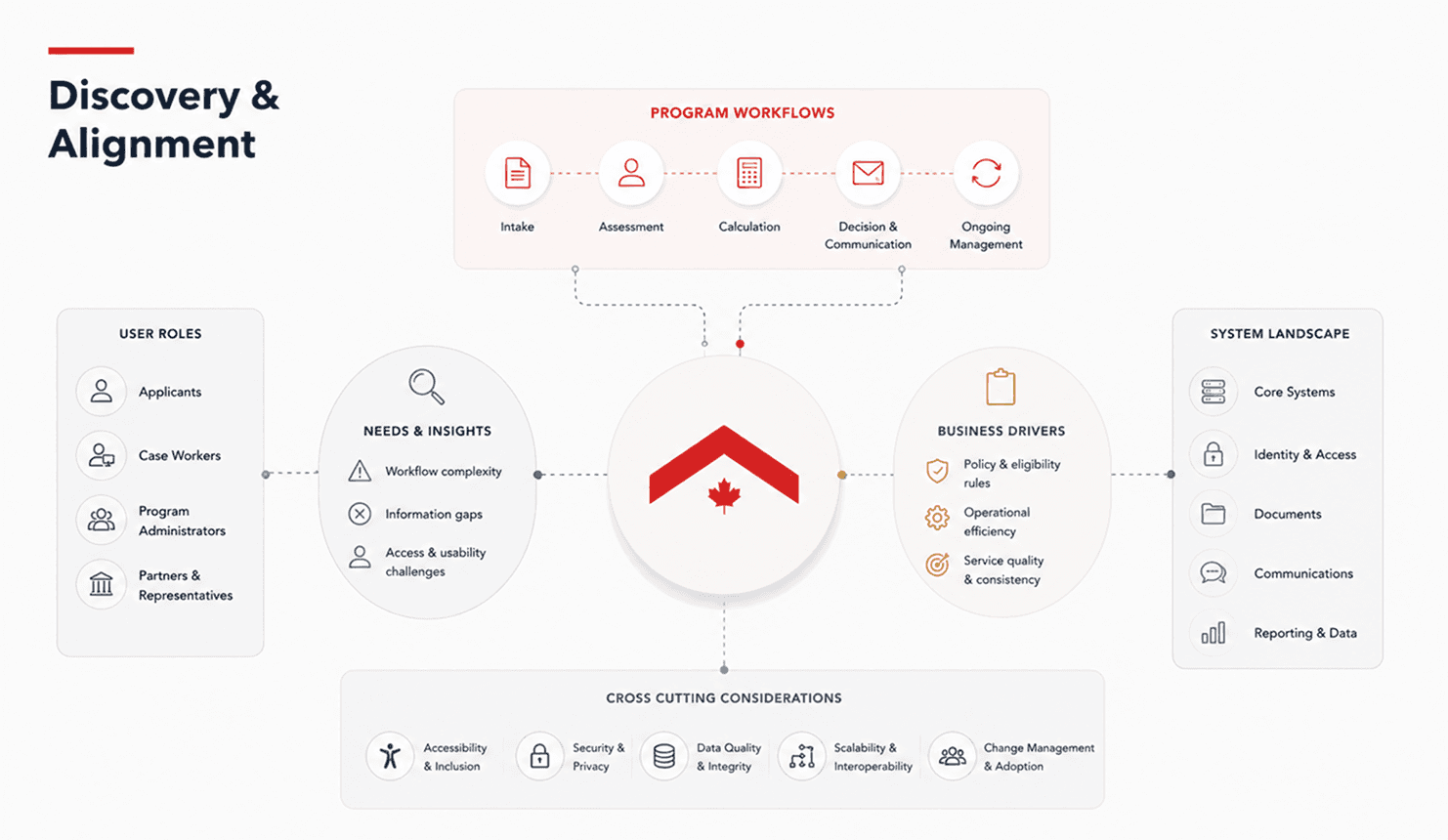
Discovery and alignment mapped the broader service ecosystem, connecting user roles, program workflows, business rules, technical dependencies, and accessibility requirements into a shared transformation view.
Role-Based Experience Design
The CMHC transformation required the platform experience to support multiple user groups, each with different responsibilities, access needs, and workflow expectations.
The work started by looking across program requirements, existing workflows, stakeholder inputs, and delivery constraints to understand how the system needed to function at both a user and operational level. Rather than treating the experience as a set of isolated screens, I approached the work as an enterprise service model — mapping where users, business rules, accessibility requirements, and technical dependencies intersected.
Through stakeholder conversations, workflow reviews, and cross-functional alignment sessions, we surfaced the areas where complexity was creating friction: unclear task pathways, fragmented information structures, role-sensitive access needs, and inconsistent interaction patterns across the authenticated experience.
These findings shaped the foundation for the transformation work. They helped define where the platform needed stronger information architecture, clearer workflow logic, reusable design patterns, and accessibility-first interaction models to support both current program delivery and future scalability.

External Users
Applicants:
Individuals applying for housing programs who require a clear, accessible, and transparent experience for submitting applications, uploading documents, understanding eligibility requirements, and tracking application status.
Lenders:
Financial institutions and lending partners who interact with the platform to submit, review, validate, and manage housing-related information while coordinating with CMHC program requirements and workflows.

Internal Users
Underwriters:
Responsible for reviewing applications, assessing risk, validating supporting information, and making program eligibility or funding decisions within structured operational workflows.
Case Workers:
Support applicants and program participants throughout the service lifecycle by managing cases, responding to inquiries, reviewing documentation, and facilitating communication between stakeholders.
Administration:
Manage operational governance across the platform, including permissions, workflow configuration, user management, and system administration activities supporting ongoing service delivery.

Operations
Fraud Team:
Monitor applications, workflows, and operational data to identify suspicious activity, investigate anomalies, support compliance efforts, and reduce program risk through structured review processes.
Service Delivery:
Ensure housing programs are delivered effectively across teams and channels by supporting operational coordination, issue resolution, and continuous service improvement initiatives.
Policy Team:
Use reporting, analytics, and operational insights to evaluate program performance, support policy development, guide strategic planning, and inform future transformation priorities.
Role-Based Access Overview

Systems Analysis
The systems analysis phase focused on understanding how workflows, business rules, user roles, and operational dependencies intersected across the housing benefits ecosystem. Rather than evaluating the platform solely from a front-end experience perspective, the analysis examined how information moved between users, systems, and operational teams.
This included identifying workflow bottlenecks, access dependencies, governance considerations, and areas where fragmented interactions created inefficiencies or increased cognitive load. Through workflow mapping, stakeholder collaboration, and service analysis activities, we identified opportunities to improve information architecture, role-sensitive workflows, navigation structures, and system interoperability. Particular attention was given to how authenticated experiences, permissions, and operational processes needed to align in order to support both usability and program integrity.
The outcome of this phase established a clearer understanding of the service ecosystem and helped define the structural foundations required to support a scalable, accessible, and operationally efficient enterprise platform.

Detailed workflow and systems analysis mapped role dependencies, approval pathways, operational friction points, and future-state opportunities across the authenticated user access lifecycle.
Transformation Strategy
The systems analysis phase focused on understanding how workflows, business rules, user roles, and operational dependencies intersected across the housing benefits ecosystem.
Rather than evaluating the platform solely from a front-end experience perspective, the analysis examined how information moved between users, systems, and operational teams. This included identifying workflow bottlenecks, access dependencies, governance considerations, and areas where fragmented interactions created inefficiencies or increased cognitive load.
Through workflow mapping, stakeholder collaboration, and service analysis activities, we identified opportunities to improve information architecture, role-sensitive workflows, navigation structures, and system interoperability. Particular attention was given to how authenticated experiences, permissions, and operational processes needed to align in order to support both usability and program integrity.
The outcome of this phase established a clearer understanding of the service ecosystem and helped define the structural foundations required to support a scalable, accessible, and operationally efficient enterprise platform.
Tranformation Pillars
Service & Workflow Clarity
The transformation needed to simplify complex program workflows and create clearer pathways for users and internal teams. This meant improving how tasks, decisions, and next steps were structured across the experience.
Accessibility & Inclusion
Accessibility had to be embedded as a core requirement, not treated as a later-stage consideration. The experience needed to support diverse users while aligning with Government of Canada accessibility expectations and inclusive design practices.
Role-Based Experience Design
The platform needed to support different user roles with varying permissions, responsibilities, and needs. This required designing workflows and information structures that were sensitive to access models and operational context.
Scalability & Reusability
The solution needed to support long-term growth across programs, teams, and future service enhancements. Reusable patterns, structured information architecture, and consistent interaction models were essential for scalability.
Operational Alignment
The experience had to align with business rules, program policies, and service delivery realities. This meant ensuring the UX supported not only end users, but also the operational logic required for efficient program administration.
Delivery Enablement
The transformation needed to be practical to implement and sustainable over time. Clear design direction, reusable frameworks, and strong collaboration across product, business, and technical teams were critical to enable delivery.
Transformation Opportunity Matrix
We used an Impact–Complexity framework to prioritize transformation opportunities based on their operational value, implementation complexity, and long-term contribution to the modernization strategy. This approach helped identify where workflow simplification, systems integration, accessibility improvements, and role-based experience enhancements could deliver the greatest impact across the housing benefits ecosystem.


Experience Architecture
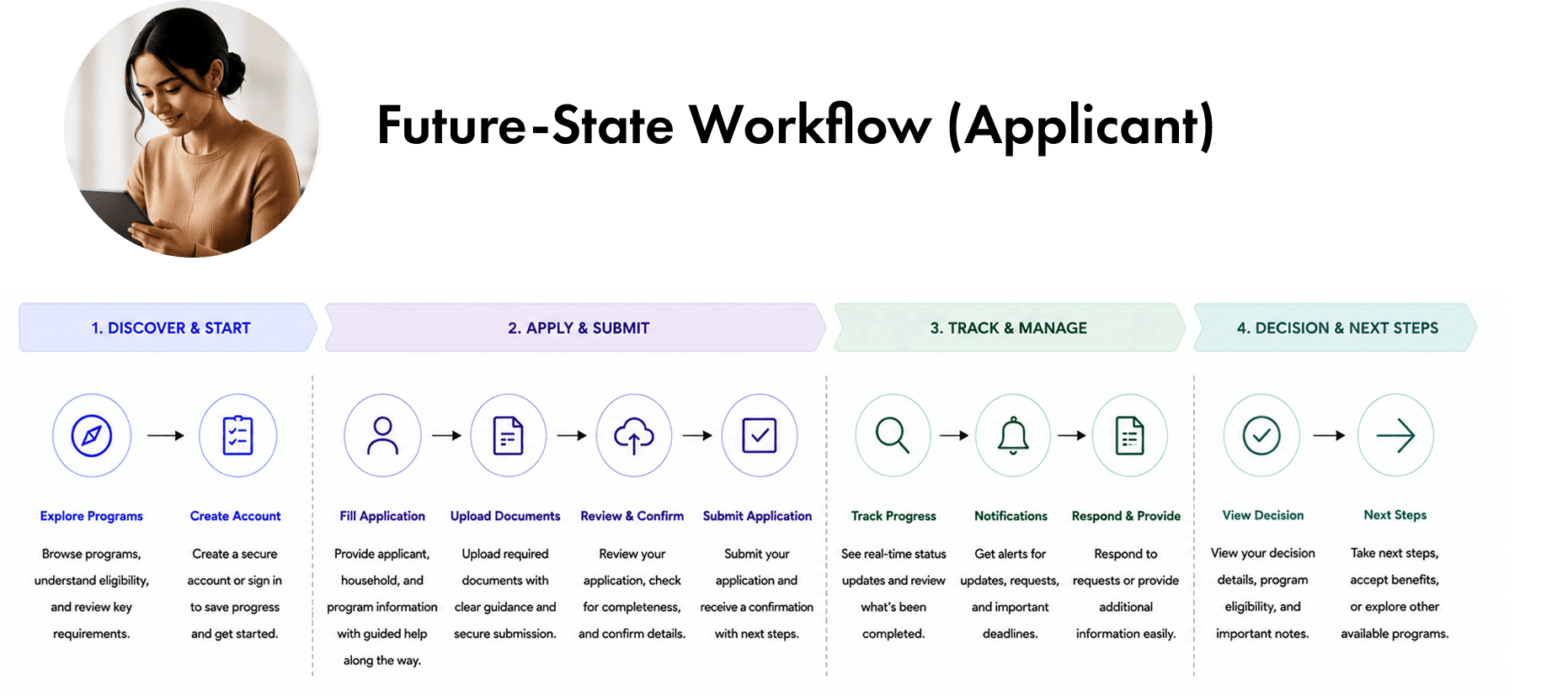
The experience architecture phase focused on translating complex operational requirements into clearer, more scalable interaction models across the housing benefits ecosystem.
Building on the findings from discovery, systems analysis, and transformation strategy, the work shifted toward defining how users would navigate workflows, access information, complete tasks, and move between interconnected service experiences. Particular attention was given to reducing cognitive load, improving workflow clarity, and creating more consistent interaction patterns across authenticated environments.
The experience architecture approach emphasized role-sensitive workflows, scalable information architecture, reusable design patterns, and accessibility-first interaction models that could support a wide range of user groups and operational scenarios. This included structuring navigation systems, workflow pathways, approval flows, and content hierarchy in ways that aligned both user expectations and enterprise governance requirements.
Through iterative exploration, prototyping, and stakeholder collaboration, the architecture evolved into a more cohesive enterprise UX framework capable of supporting operational efficiency, future scalability, and long-term modernization goals across the platform ecosystem.


Delivery Enablement
The delivery enablement phase focused on aligning stakeholders, operational teams, and delivery partners around a shared transformation direction while supporting the transition from strategy into implementation.
As workflows, interaction models, and future-state concepts evolved, regular stakeholder shareouts and collaborative review sessions were used to communicate design decisions, validate operational impacts, and support alignment across product, business, UX, and technical teams. These activities helped ensure modernization efforts remained grounded in both user needs and organizational realities.
The enablement approach emphasized cross-functional collaboration, implementation readiness, operational transparency, and scalable delivery practices that could support ongoing iteration and long-term transformation goals. Particular attention was given to communicating workflow changes, role impacts, governance considerations, and systems dependencies in ways that supported decision-making and organizational buy-in.
Through structured shareouts, prioritization activities, and collaborative planning sessions, the transformation direction became more actionable, helping teams move toward a more unified, scalable, and operationally aligned enterprise experience.

Stakeholder shareouts and collaborative review sessions helped validate workflow direction, communicate transformation recommendations, and align product, business, UX, and operational teams around future-state experience and risk-management strategies.
Validation and Iteration
The validation and iteration process for the CMHC Housing Benefits Transformation initiative focused on refining workflow clarity, role-based experiences, accessibility, and operational usability across complex service delivery environments.
Interactive prototypes, workflow models, and future-state concepts were reviewed through collaborative sessions with program teams, operational stakeholders, service delivery staff, and business representatives. Feedback highlighted challenges related to fragmented workflows, inconsistent navigation patterns, role-sensitive access requirements, and the complexity of managing operational tasks across multiple systems.
Insights gathered through these sessions informed iterative refinements to workflow architecture, information hierarchy, reusable interaction patterns, and authenticated user experiences. This iterative approach helped ensure the future-state platform direction was scalable, accessible, operationally aligned, and better positioned to support long-term digital transformation objectives.
Key Validation Findings
Workflow Clarity & Task Sequencing
Validation sessions identified opportunities to simplify complex workflows, clarify next steps, and improve task sequencing across program delivery activities. Iterations focused on creating more intuitive user flows and reducing operational friction.
Role-Based Access & Permissions
Stakeholder feedback reinforced the importance of role-sensitive experiences and clearer permission structures across internal and external user groups. Iterative refinements improved how workflows, navigation, and actions adapted based on user responsibilities and operational context.
Navigation & Information Architecture
Testing revealed inconsistencies in how users located information, managed cases, and navigated between related tasks and records. Updates focused on improving information hierarchy, workflow visibility, and enterprise navigation structures.
Scalability & Reusable Patterns
Operational teams emphasized the need for reusable workflow models and consistent interaction patterns that could scale across programs and future enhancements. This informed the development of more modular and adaptable experience frameworks.
Accessibility & Usability
Validation activities surfaced opportunities to improve readability, accessibility compliance, interaction clarity, and cognitive load reduction across authenticated experiences. Iterations prioritized inclusive interaction models and clearer communication patterns.
Operational Alignment & Service Delivery
Cross-functional review sessions helped validate that future-state workflows aligned with operational processes, governance requirements, and service delivery expectations. Iterative collaboration ensured the transformation direction remained practical, implementable, and operationally viable.
Conclusion
The CMHC Housing Benefits Transformation initiative established a stronger foundation for a more scalable, accessible, and operationally aligned digital service ecosystem supporting housing program delivery across Canada.
Through a systems-level UX and service design approach spanning discovery, workflow analysis, transformation strategy, experience architecture, and delivery enablement, the work helped bring greater structure and clarity to complex program operations. By aligning user needs, business rules, accessibility requirements, and operational workflows, the transformation direction supported both immediate service delivery improvements and long-term modernization goals.
Key outcomes included clearer role-based workflows, improved navigation and information architecture, stronger operational transparency, and more scalable interaction models for authenticated enterprise experiences. The initiative also reinforced the importance of cross-functional collaboration, iterative validation, and enterprise design thinking when modernizing complex public-sector systems.
The result was a more cohesive and future-ready service framework designed to reduce operational friction, support accessibility and governance requirements, and create a more consistent experience for applicants, internal teams, and operational stakeholders across the housing benefits ecosystem.
