Public Health Agency of Canada

Project Context
In response to a national crisis, the Public Health Agency of Canada turned to us to design and deliver a functional vaccine distribution portal. Leveraging our expertise in UX best practices and product design, we worked at an accelerated pace to ensure Canadians had seamless access to vaccinations.
The platform needed to clearly communicate essential information, provide public health centers with an intuitive vaccine ordering system, and enable administrators to efficiently track and confirm deliveries. Additionally, the solution adhered to Canadian government style guides and web toolkit standards while prioritizing a mobile-friendly experience for broad accessibility.
Role
Senior UX/UI Designer
Collaborators
Product Owners, Creative Director, Business Analyst, Developers, Subject Matter Experts
Project Timeline
6 months
Methods and Tools
Design Thinking, Design System, Figma, Miro, Microsoft, Adobe, Jira
Process
Given the urgency of the project, we streamlined our process by minimizing time spent on discovery and ideation, focusing instead on rapid execution.
Rather than conducting extensive research, we leveraged existing insights from government stakeholders and prior public health initiatives to define user needs quickly.
To accelerate ideation, we relied on proven UX patterns, aligning with Canadian government design standards and digital toolkits. Low-fidelity prototypes were developed in parallel with early development work, allowing for immediate validation and iteration. Usability testing was conducted in short cycles, focusing on critical user flows to ensure clarity and efficiency. This rapid, iterative approach enabled us to deploy a functional vaccine distribution portal within a condensed timeline while maintaining usability and compliance standards.



Discovery
Due to the project's urgency, the discovery phase was streamlined to focus on critical research and stakeholder alignment.
Rather than conducting extensive user interviews and journey mapping, we leveraged existing government reports, public health data, and direct input from Public Health Agency administrators. This allowed us to quickly define core user needs—ensuring public health centers could efficiently order vaccines and administrators could track deliveries. By prioritizing speed, we focused on extracting key insights from subject matter experts, reviewing established Canadian government digital standards, and identifying constraints early to guide design and development without delays.
Design Requirements
Straightforward Ordering Process
Public health centers needed an intuitive interface to place vaccine orders quickly and efficiently, minimizing friction in a high-pressure environment.
Mobile-Friendly & Accessible UI
Given the diverse range of users, the platform had to be fully responsive, WCAG 2.1 AA compliant, and optimized for mobile use.
Scalability & Reliability
The system had to handle fluctuating demand, supporting a seamless experience even during peak usage.
Real-Time Tracking & Confirmation
Administrators required a transparent system to monitor vaccine shipments, verify deliveries, and manage distribution logistics.
Government Branding & Compliance
The platform followed established Canadian government style guides and design system components to ensure consistency and usability
Clear Messaging & User Guidance
The interface needed concise, action-driven content to help users navigate the process effortlessly, reducing errors and support requests.
Use Cases
To create an intuitive and efficient digital experience, the team outlined key user personas and their core task flows, enabling us to identify and prioritize essential features for the MVP.

Public Health Center Administrator:
Needs a fast and reliable vaccine ordering system to manage stock, solved with an intuitive platform featuring real-time inventory updates and automated confirmations.

Provincial Health Authority Manager:
Struggles with tracking vaccine distribution across multiple locations, addressed through a centralized dashboard with shipment updates and historical order data.

Government Logistics Coordinator:
Requires real-time visibility into vaccine shipments, resolved by integrating live tracking and estimated delivery times.

Ensures regulatory compliance across the system, supported by built-in compliance checks and standardized workflows.

IT Support Specialist:
Manages technical issues for users, alleviated by a self-service help center with guides, FAQs, and a ticketing system.

Mobile Health Outreach Coordinator:
A consistent, easy-to-use system for internal knowledge-sharing and collaboration.
Utilizes internal training decks, onboarding materials, and resource libraries to ensure alignment across teams and maintain a unified brand presence.
Ideation
We condensed the ideation phase into three intensive working sessions.
The first session focused on brainstorming, where stakeholders rapidly outlined key user needs and pain points. In the second session, we conducted lightning sketches, enabling the team to visualize quick, low-fidelity concepts for the platform’s core workflows. Finally, we used an Impact-Effort Matrix to prioritize features—identifying high-impact, low-effort functionalities that could be implemented quickly while deferring complex, low-priority elements for later iterations. This streamlined approach ensured we had a clear, actionable design direction while keeping delivery timelines tight.
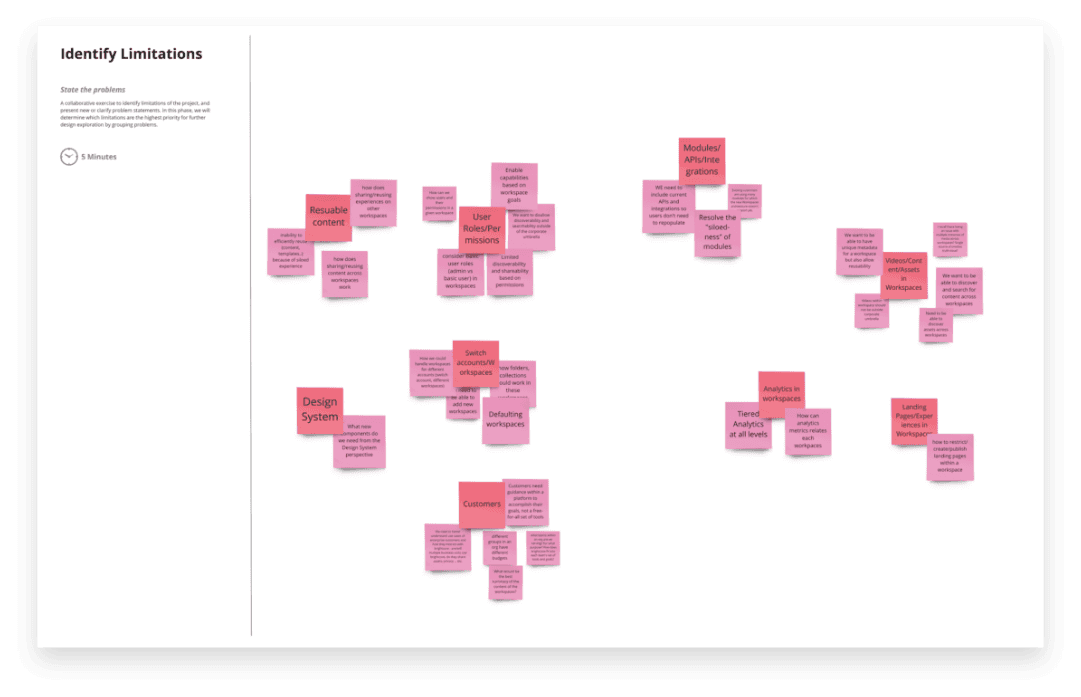

Brainstorming Session, Ideation clustering, and lightning sketches


Prototyping
Given the urgency of the project, the prototyping process was streamlined to ensure rapid iteration and validation.
Low-fidelity wireframes were developed early to establish core user flows, focusing on vaccine ordering, shipment tracking, and compliance reporting. These wireframes were refined through three rapid feedback loops with stakeholders, ensuring alignment with real-world needs.
Once the structure was validated, the team moved to high-fidelity prototypes, incorporating government-mandated UI components for consistency with existing public health platforms. Clickable prototypes were then tested with key users—clinic administrators, logistics coordinators, and provincial health authorities—to identify friction points and optimize usability before development began.
This lean, feedback-driven approach allowed for a functional, user-approved prototype to be ready within weeks, setting the stage for efficient development and deployment.

Landing page, and order submission form
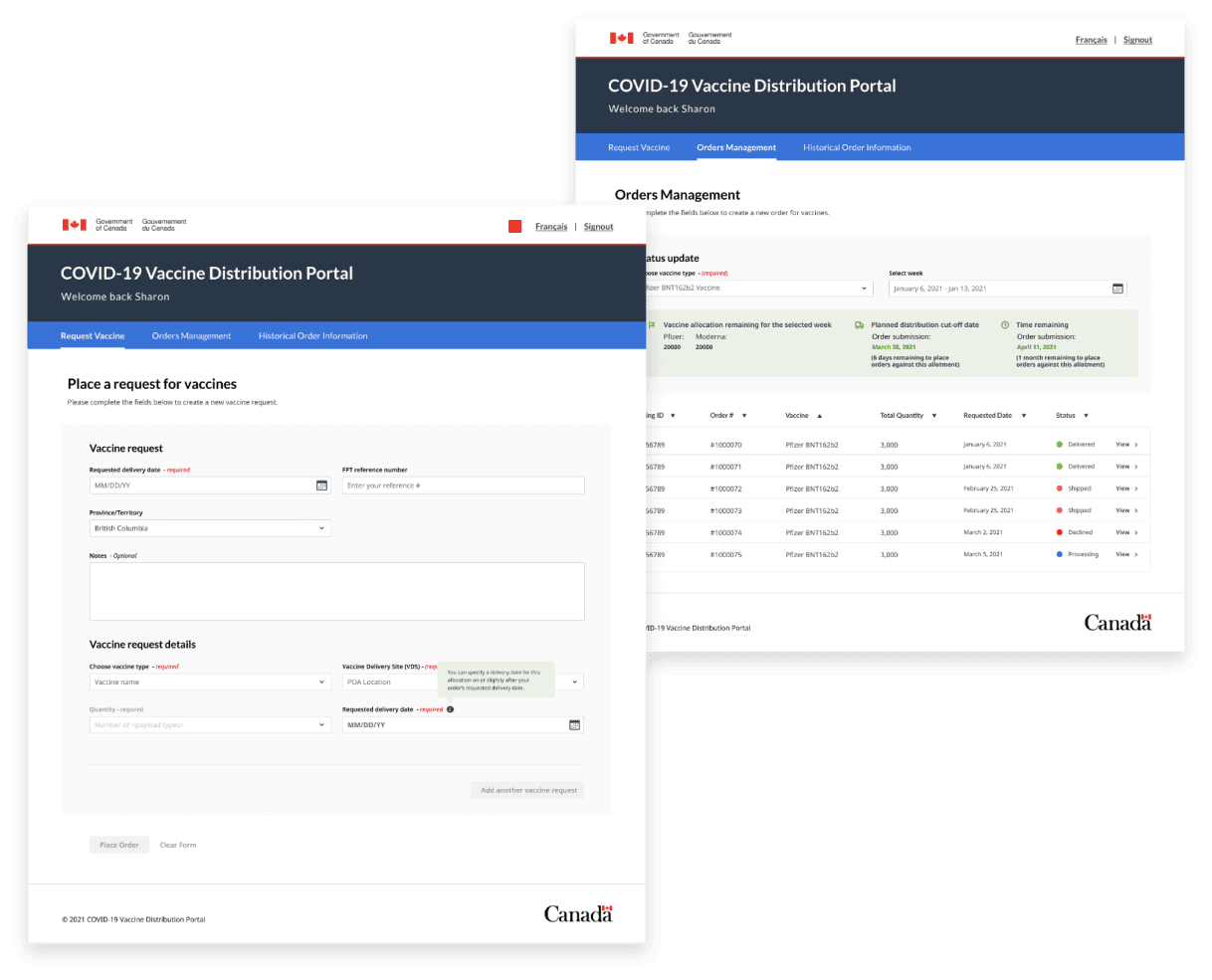
Order form and administrative tracking
Usability Tests
To ensure the platform met the needs of diverse users, usability testing was conducted in two rapid cycles with key stakeholders, including public health administrators, logistics coordinators, and compliance officers.
Testing focused on task completion efficiency, error rates, and user satisfaction across core functions like vaccine ordering, shipment tracking, and compliance reporting.
The first round involved remote moderated testing, where participants completed predefined tasks while providing real-time feedback. This helped identify navigation issues and workflow bottlenecks. After quick design adjustments, a second round of unmoderated testing was conducted to validate improvements in a real-world setting.
Findings were categorized into six key areas: ease of use, task efficiency, accessibility compliance, error prevention, system responsiveness, and user confidence. The feedback led to refinements, such as clearer form validations, enhanced mobile usability, and optimized search functionality, ensuring a seamless experience before full deployment.
Findings
Ease of Use
Users found the ordering system intuitive but needed clearer navigation cues, leading to improved menu structures and call-to-action buttons.
Accessibility Compliance
Initial tests revealed minor contrast and readability issues, resulting in WCAG-compliant color adjustments and improved text hierarchy.
System Responsiveness
Slow-loading dashboards frustrated users tracking shipments, prompting backend optimizations and performance improvements for real-time data updates.
Task Efficiency
Some workflows required too many steps, particularly in vaccine reordering, prompting a streamlined process with fewer clicks and automated suggestions.
Error Prevention
Users occasionally submitted incomplete orders due to unclear validation messages, leading to real-time error feedback and required field indicators.
User Confidence
Some participants hesitated when confirming orders, so additional confirmation prompts, tooltips, and success messages were added to reassure users.
Conclusion
The Public Health Agency of Canada’s vaccine distribution portal was a high-impact project that required rapid execution without compromising usability, efficiency, or accessibility. By streamlining the discovery and ideation phases, we were able to quickly define key user needs and prioritize features.
As a result, vaccine distribution was significantly improved, with faster order processing, real-time tracking, and a seamless user experience. This project demonstrated the power of agile design thinking in high-stakes environments, delivering a critical digital solution that empowered public health officials to efficiently distribute vaccines across Canada.

95% of public health centers onboarded within the first three months of launch

100% adherence to federal digital accessibility and security regulations.

Real-time tracking enabled a 40% decrease in order status inquiries from public health centers

85% user satisfaction rating, based on post-launch feedback surveys.

1 year later
One year after the launch of the Public Health Agency of Canada’s vaccine distribution portal, follow-up assessments showed significant long-term improvements in efficiency, accessibility, and public health outcomes.
The platform was successfully repurposed for other medical supply distribution, including childhood immunizations, flu vaccines, and critical medications.
30% increase in total orders processed as the system expanded beyond COVID-19 vaccines.
The adaptability of the system saved an estimated $2.5 million in development costs by avoiding the need for a separate medical distribution platform.
The platform’s continued success highlights its role in optimizing vaccine distribution and supporting public health initiatives across Canada while proving adaptable for broader medical logistics needs.

Order processing time reduced by 65% compared to pre-launch processes.
100% of public health centers adopted the system, with all provinces and territories actively using the platform.
